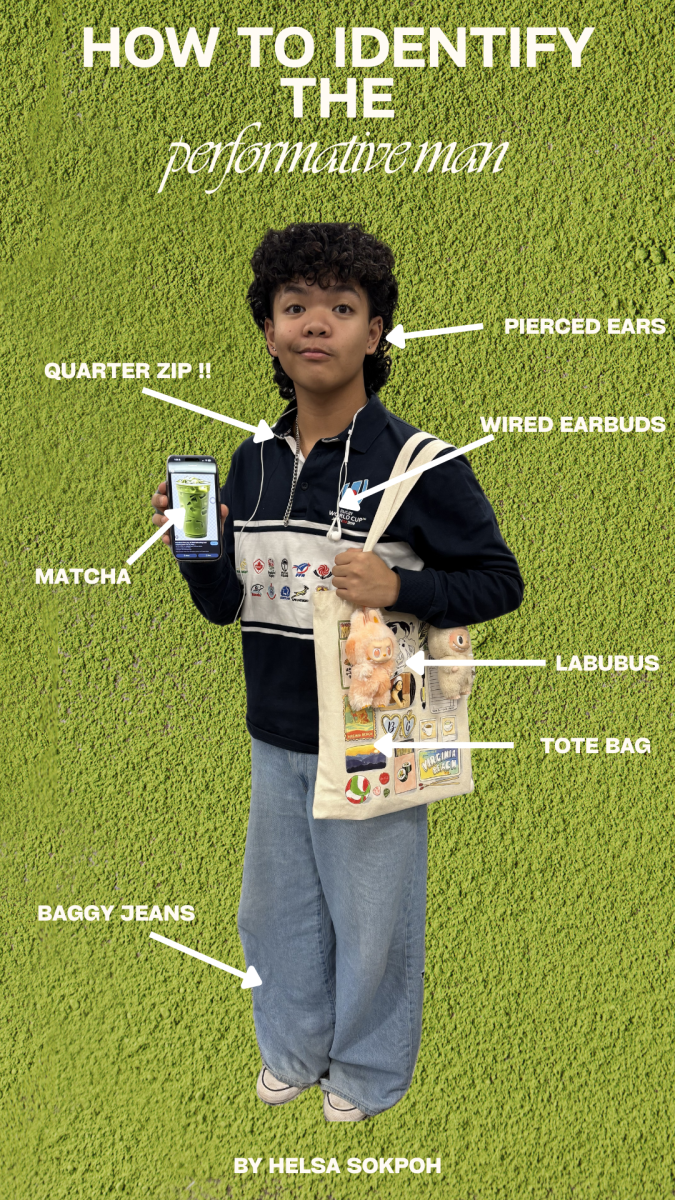
If you’ve spent over five minutes on TikTok lately, you’ve probably encountered the performative man trend. His morning coffee is replaced with matcha, his wired headphones are blasting indie pop artist Clairo, and he always has a feminist literature book in hand. Most importantly, his outfit is carefully chosen to say one thing: “I’m not like other guys.”
The most important aspect of the performative man trend is presentation. It’s centered on the idea that refinement is something that should be visually demonstrated: matcha signals wellness, Labubus signal niche taste and disposable wealth, and now, fashion has joined the checklist.
The new trend circulating on TikTok praises quarter zips, with the creator Jason Gyafami posting a video stating, “I’m a quarter zip dude now, I don’t do that Nike Tech stuff.” In this video, he frames the look as classy and “put together.” Essentially, the quarter zip represents everything that Nike Tech is not. The sport sets are associated with streetwear, which is now being labeled as “immature.”

These choices are less about personal enjoyment and more about signaling cultural capital. At first glance, the styling tip sounds harmless, and the memes emerging from it were funny and creative. However, as the trend gained traction, deeper issues of politics, classism, and racialized stereotypes emerged online.
“I noticed the trend in early November, but I didn’t expect such a simple style to be so popular. Quarter zips are not very creative and have been worn for a long time,” said junior Noah Kala.
One of the most prominent themes emerging from the quarter zip trend is a modern version of respectability politics, which historically refers to the belief that marginalized groups must conform to dominant social norms in order to be accepted or respected. On TikTok, this idea reappears through fashion advice, where creators suggest that layering a quarter zip over athletic wear makes an individual look more “professional.”
The issue is not the quarter zip itself, but the moral weight attached to it. When creators frame certain outfits as upgrades that make someone look presentable, while others are seen as lower class, they imply that dignity is conditional. Such logic suggests that respect is earned through conformity rather than something inherent. This trend also taps into classism, as the quarter zip is associated with preppy, upper-middle-class professionalism. However, Nike Tech, despite being a high-priced branded item, is framed as lower status due to its cultural associations with streetwear and urban youth. The irony of it all is that both items often cost comparable amounts, yet one is praised as refined while the other is treated as a liability.
This contrast exposes how class is not determined by cost but by cultural perception.
“People with expensive clothes are seen as ‘cooler’ and ‘higher status,’” said Kala.
TikTok’s framing suggests that class is something that can be visually performed through adherence to specific aesthetics.
The impact of this trend is especially pronounced when considering who is most often targeted by its messaging. Videos criticizing Nike Tech aesthetics disproportionately focus on Black men, reinforcing long standing stereotypes that associate Black masculinity with aggression and lack of professionalism.
These stereotypes are not new, but TikTok repackages them in a way that feels casual and apolitical. By framing these judgements as fashion advice rather than social critique, creators avoid accountability while still maintaining harmful associations. The result subtly encourages certain groups to modify their appearance to avoid negative perceptions.
What makes the performative man trend particularly powerful is its normalization. When millions of users engage with content that ranks clothing choices on a moral scale, these ideas start to feel like common sense rather than social constructs. This trend does more than reflect taste; it actively shapes behavior, teaching impressionable viewers what is “acceptable” and “respectable.”
As TikTok continues to influence how young people understand identity and success, trends like this raise important questions. Why are certain aesthetics treated as neutral while others are stigmatized? At what point does personal style turn into self policing? What looks like a fashion trend may, in reality, be another reminder that respect in digital spaces is often conditional and unevenly distributed.