With AI chatbots on almost every online service, AI overviews accompanying the majority of search browsers, AI-generated advertisements posted on practically every social media platform, and the implementation of AI in even some household appliances, it seems that in today’s age AI is forcing its way into practically every facet of life, and the use that remains perhaps the most controversial is the usage of generative AI in the arts.
With some finding the use of generative AI to be almost antithetical to the creative process and art itself, and others viewing the technology as a viable means of “democratizing the arts” and making the medium more accessible, the use of AI for creative works has been a hot topic for a few years now. I remember when I was first introduced to the concept of AI-generated art. It was a few years ago when the program Dall-E by OpenAI had just come out, claiming that it could allow you to generate works of art with the typing of a few words. I didn’t pay it any mind then and thought of it more as a sort of new, gimmicky tech that would catch some attention for a handful of weeks and quickly retreat into irrelevance. How wrong I was.
Now the technology has managed to seep into every aspect of art: from visual arts to photography, to filmmaking, to literature, and even to music. If you’ve been on YouTube, Instagram, or even streaming platforms like Spotify recently, chances are you’ve encountered some form of AI-generated music. In fact, AI-generated “artists” and AI slop have recently become quite the problem on Spotify in particular, with a few having already gained a significant amount of traction on the platform, racking in thousands and even millions of streams. A few examples of such “artists” include the psychedelic rock group The Velvet Sundown who a few months ago was forced to admit that all photographs and music for the group was AI generated, the more recent case of AI soul “singer” Sienna Rose, and the case I find to be the most interesting: the R&B “artist” Xania Monet who managed to make it onto the top of the R&B Billboard chart.
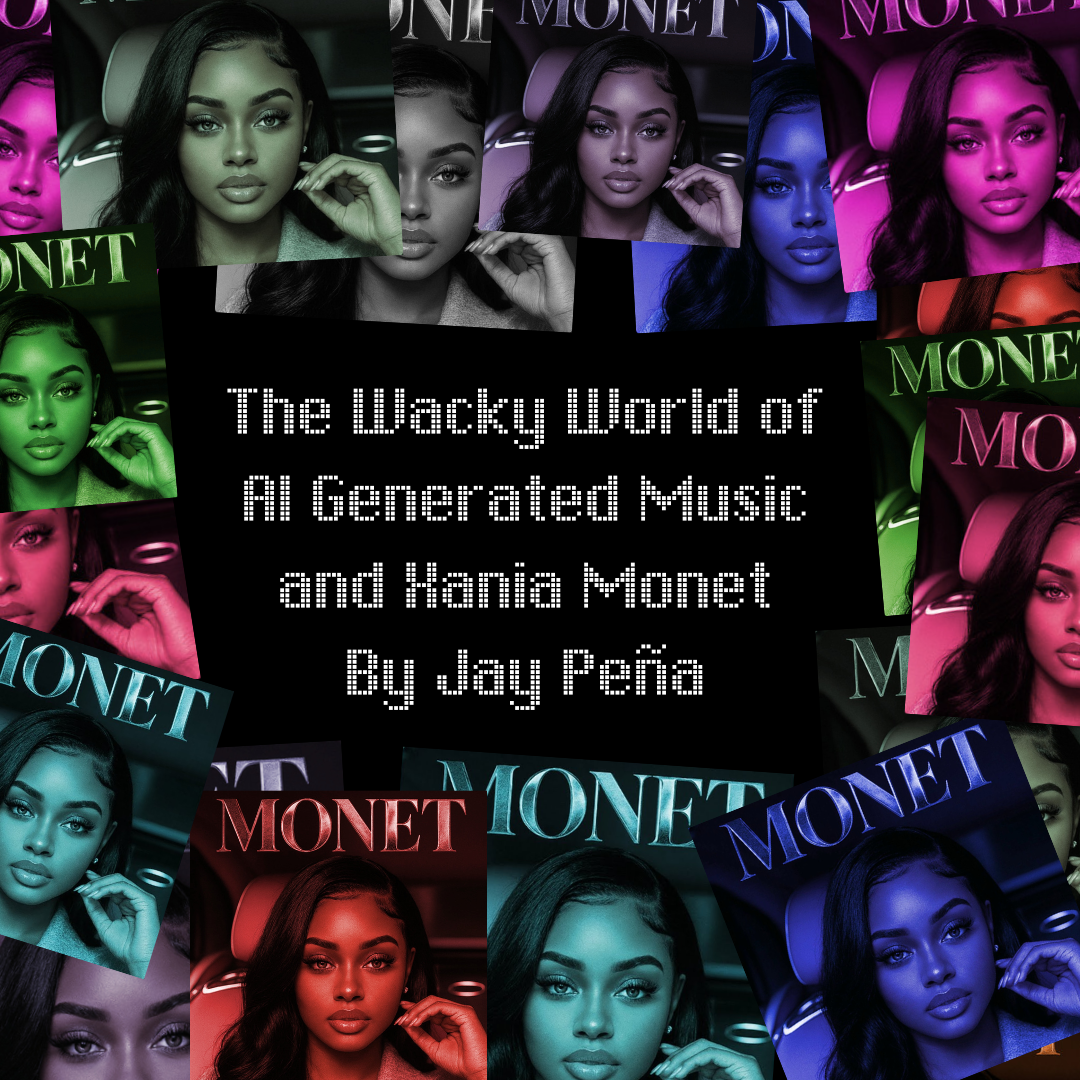
Xania Monet is truly my favorite instance of AI-generated music, mainly because of how incredibly, ridiculously, and almost impressively lazy every aspect of her (its?) “work” is. If you just glance over the Spotify profile made for Monet, you see that almost every single that has been released uses the exact same, presumably AI-generated, image of Telisha “Nikki” Jones, the human behind the avatar of Monet, but with a different colored filter overlaid on top for each cover.
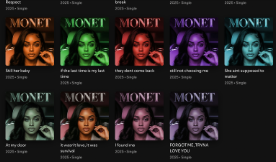
Moreover, the titles used for the songs generated for Monet are some of the most hilarious and utterly absurd titles I have ever seen. Some of my personal favorites are “We Only Link At Funerals,” “The receipt that never expired,” “They don’t love like Grandma Did.” Yes, these titles are actually spelled and capitalized exactly as I have written them here; they are just that bad. And, of course, we can’t forget the classic “Miscarriage Blues.” Needless to say, when I saw these lovely album covers and thoughtful titles, I knew I was going to be getting myself into something really “special”, to say the least.
Monet’s “music” is best described as a soulless assortment of every R&B cliché from the 2010s, usually accompanied by painfully generic, “sad” sounding piano and some very unsubtle lyrics about whatever unoriginal topic Jones decided to write a sentence or two on in a Sunno prompt. Though, fortunately or unfortunately, the lyrics of Jones’ are one of the only things that Jones actually created herself, coming from poems she writes on her phone, which makes the fact that they’re so blasé and bland a shame. Really, the songs aren’t as bad as they are dull. There’s only one aspect of the slop ( I do feel that term is apropos here) generated that I find even remotely entertaining which is the vocal’s complete inability to do any natural sounding runs and highnotes with the comedically bad AI voice that ranges from sounding like something similar to an actual human woman (albeit with poorly applied autotune), to just a soulless, lifeless robot that sounds about as charismatic as the grating fuzzy shrieks of dial up internet.
With such boring and lifeless music, music that I had never even heard or known about until learning that Monet had made it onto the Billboard charts, I have to question if the millions of streams of the songs generated by Jones under the name of Monet have been inflated in some form or another. Among the many problems present on the Spotify platform, artificial streams have been a pretty big issue for the streaming service, alongside the previously mentioned AI artist and slop dilemma.
I think what is really interesting about Xania Monet as an avatar is not the music released under its name, because honestly, there is absolutely nothing of any real interest in Monet’s “discography,” but what the character means for music as a whole, both as an art and an industry. In fact, it was only a few months ago that Jones was able to secure a $3 million record deal for Monet. Moreover, music industry giants such as Universal Music have already been negotiating deals with AI companies. While there have been some artists who have come out to take a position against the implementation of generative AI in the music space and creative spaces generally, such as the real-life R&B singer Kehlani, having spoken out against Monet, there still remains a great deal of uncertainty as to how generative AI will further impact artists and where the technology will go from here.
The most glaring issue with AI-generated music, as well as the use of generative AI for art at large, is simply the fact that the technology is fundamentally opposed to the creative process. In fact, I’d go as far as to say that there is no creative process when generative AI is used for art. There’s typically no thoughtfulness, no emotion, and no effort to be found within this practice; There’s only a box for typing in a prompt about a sentence long and having a collection of (more than likely partially plagiarized or stolen) results regurgitated. There’s no creativity or artfulness; there’s only an input and an output. In that sense, even bad art would be more valuable than AI art. At least the poorly received art was a genuine attempt at something that required a human effort to accomplish. That’s certainly saying more than anything generated via AI. This sentiment is mirrored by others I’ve talked with on the topic as well.
“I think using generative AI for music takes away from the people who actually put time and effort into songs,” said junior Sariah Stevens. “Some AI music sounds almost soulless when music is usually all about emotion and bringing out emotions in others.”
Indeed, the term “soulless” is one frequently attributed to the outputs generated by AI alongside a slew of other, usually negative, terms that could be applied to the sounds AI manages to produce and generative AI itself.
“I can’t, and would refuse to, enjoy anything that is AI-generated due to its ethical issues,” said senior Emma Miller. “It also just plain sounds soulless and janky due to the AI’s inability to process noise
However, one could go even further when criticising the use of generative AI, especially when considering the implications AI has for art as a concept.
“Generative AI has no place in the contemporary world, period,” said Miller. “But it has even less of a place in creative spaces such as music. Music has been a part of nature since there existed the ability to hear sound, and it has persisted through millions of years to where we are today, existing as one of the few universals across all human cultures and history. So for something like that to be diminished by a generated noise is a dishonor and insult to the world.”
While I generally try to be open about the use of new and different methods of art creation, AI art, at best, is a lazy means of replicating the results of an artist’s creativity and effort without actually possessing either trait, and at worst, represents the devaluation of artists and art as a whole. As silly as I find a lot of the things generated by these AI “artists” like Xania Monet, I must admit, there is something deeply upsetting about seeing the “music” created by a person who seemingly has no attachment to her work nor engageent with the craft that she is profiting from rise to the top of Billboard charts while other artists who do value their work and take pride in their art fall by the wayside.
Granted, while artists being overlooked and struggling to succeed in their given careers is by no means a new thing, I can only imagine how much more difficult achieving some form of success as an artist would be today when it’s not just competition amongst your contemporaries in already merciless industry, but against machines run by people who care little for artistry or personal expression churning out hundreds of songs a year, songs that could have been generated on a program that used your work, the product of your creativity, emotions, and effort, to train itself without your approval or knowledge.
What makes this whole situation more sad is the fact that I genuinely believe Jones and every other person who uses generative AI in place of talent could actually learn how to be artists and create all on their own. If people like Jones were to practice their writing, or begin learning an instrument, or just interact with artists in their field with the intention learning, I’m sure they would begin find themselves able to create work just as good, if not better than AI, and I feel confident that this work would be more meaningful and enriching not just to their audience but to themselves. The work wouldn’t just be an output generated by a machine for the sake of profit, but something they put their finite time and effort into. However, actually applying yourself means having to try, potentially fail, or even be discomforted in an attempt to grow and improve your work, and if Monet’s music is anything to go by, those who use generative AI to replace creativity don’t care much about growth or development so long as it’s monetary. As a result, the work produced by Monet and the many similar “artists” ends up being shallow in its conception, lazy in its execution, and overall a distasteful experience as music.