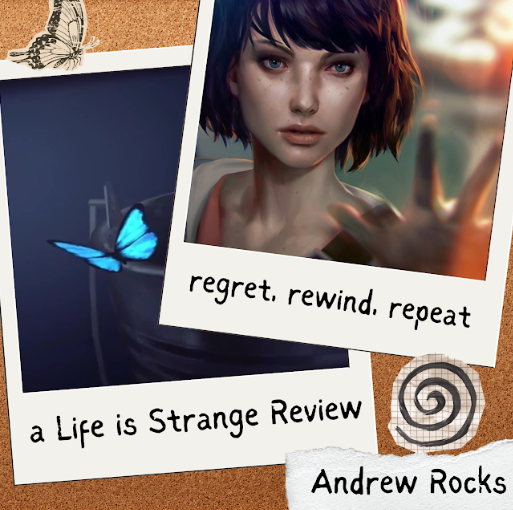
Life is Strange, released in 2015, is a timeless (pun intended) game filled to the brim with mystery, riddles, and hidden clues all coalescing to make a beautifully-crafted story that allows the player to handcraft their experience. In this game, choice matters. One small choice, such as answering a short phone call, can completely shift the trajectory of future events.
After experiencing a vivid premonition of a supernatural tornado destroying Arcadia Bay, photography student Max Caulfield discovers she possesses the extraordinary ability to rewind time when she instinctively reverses a fatal accident in her school’s bathroom.
By triggering a fire alarm to save the victim, Max alters the course of the day, leading to a tense confrontation with the wealthy and volatile Nathan Prescott. Her escape is aided by the very girl she saved, revealed to be her estranged childhood best friend, Chloe Price, which sparks a reunion where the two begin to reconcile. As Max confides in Chloe about her apocalyptic visions, she learns of the haunting mystery surrounding Rachel Amber, Chloe’s missing friend, setting the stage for a journey defined by time manipulation and deep-seated town secrets.
I think Episode One, Chrysalis, was a perfect introduction to the mechanics, characters, and overall story of Life is Strange. Every scene has little details that aren’t crucial to interact with, but I love exploring every area and examining every object I can to learn all about the fictional setting of Arcadia Bay. Some interactables will give you extra dialogue options, opening new paths for the story to take. You are rewarded for exploring, but never punished for moving quickly, allowing every player’s experience to feel unique.
The characters in Life is Strange feel like real people rather than standard NPCs. My favorite side character is Alyssa Anderson. In each episode, Alyssa finds herself in a series of unfortunate accidents, getting hit by a football, pushed into a pool, or splashed by a puddle. It isn’t immediately obvious, but you can choose to rewind and warn her. If you do, she shows genuine appreciation. Another standout is Victoria Chase. Although she serves as an antagonist, I love what her character represents and how her dynamic with the main cast is executed. Her character arc is heavily influenced by how you choose to treat her, which shows the game’s depth.
Max’s rewind power can be confusing at times, but I believe it was perfectly executed. Of course, there are times where it breaks the immersion and leaves you wondering, “how don’t these people know I can rewind time?” but I still enjoy it as an integral mechanic. A widely known detail is that while using the power, you can hear distorted dialogue from future episodes, which lets you try to guess what may happen. The best thing about Max’s rewind power is that it doesn’t feel like it was put in the game just to have it. The developers did an amazing job making sure that it felt like part of the world, especially with how Max and Chloe react to it.
The plot of Life is Strange is constantly engaging, and I always found myself struggling to put it down after finishing an episode. I never thought a game could make me emotional, but I ended up sobbing a few times in the last three episodes. The developers of this game know how to make a good game, and it shows with the amount of passion they put into this project. I don’t know enough words to sing the praises I have for this game. The amount of love and appreciation I have for this whole series is honestly embarrassing.
If you haven’t played it, spend the $20. Play it over and over, find every secret, and be prepared; just like me, you might end up emptying your wallet to buy every other game in the series. In my opinion, it’s absolutely worth it.