To the average adult, your tank top may just be a tank top, but to the Gen Z teenagers who spend hours doom scrolling on Depop before bed, it’s a vintage Y2K staple with a hint of minimalism that’s absolutely perfect for layering. On Depop, a decade-old online marketplace for secondhand fashion, no piece of clothing is ever just clothing, as closet essentials instead become curated pieces waiting to land in someone else’s closet.
The app, which has garnered 56 million users worldwide, functions similarly to Poshmark but seamlessly combines social media and thrifting to appeal to younger generations. At first glance, the app can be easily mistaken for Instagram with its red undertones and post-like feed, as users can even follow popular curators, message sellers, and gain early access to collections launched by brands like DKNY and MAC Cosmetics.
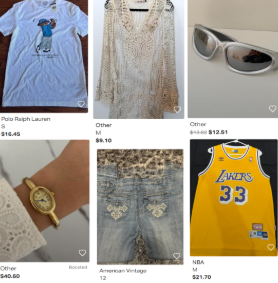
“I’ve used multiple thrifting apps like Poshmark, Mercari, and eBay, and Depop is the easiest one to manage because of the way it’s organized,” said senior Kiana Cabanayan. “Gen Z kids get overwhelmed when there’s too much to read and look at, so it’s easy to navigate. Depop has such a unique way of organizing their algorithm because they just don’t organize the tops, pants, and shoes, but they tweak it towards your style, what you want, and what you like.”
According to Depop’s newsroom, the guiding principle behind the platform is “circularity,” meaning that all clothing should be worn as long as possible through the “wear, resell, repeat” cycle. Depop prides itself in its community impact by not only reducing net zero emissions and increasing sustainable operations, but also by working to eliminate the fast fashion industry completely.
“Fast fashion is harmful because it indirectly puts clothes straight into landfills,” said senior Makenna Jordan. “The trend cycle that fast fashion feeds into continues to grow more and more, causing trends to die out quicker. Depop fights against this by allowing customers to purchase second hand clothing online. I like to sell on Depop because it gives the clothes that I no longer wear another chance to be worn, which is a very helpful way to combat fast fashion ending up in landfills.”
Besides its environmentally-friendly impact, new buyers have noted how easy the app is for beginner thrifters to use. Buyers can connect with sellers at the tap of a finger, easily view an item’s shipping status, and put digital outfits together with pieces of clothing that the user has shown interest in.
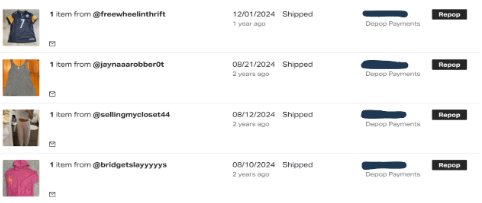
“I sell very rarely, but buying differs,” said senior Chloe Pastrana. “On average, I would say I buy at least once every two weeks. I think Depop is an amazing platform that’s extremely easy to navigate. When you first start, it gives you many steps, and then when you really start using it, you realize how much work it does for you. It’s super easy to pick random items that pop up and send in an offer. It really is such a good app.”
On the other hand, Depop is an extremely convenient platform to begin selling on. It’s free to post a listing, and users make more profit than when they take their clothes to Plato’s Closet or Uptown Cheapskate, for example. For users concerned about their bank account getting hacked, the platform is completely safe, with payouts being made after item delivery.
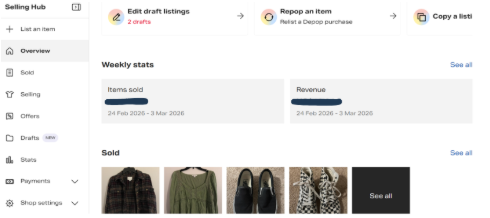
“I’ve sold 12 items on Depop, and I have 46 listings,” said senior Victoria McNulty. “I don’t use it as much anymore, but whenever I did, it was pretty easy to navigate. Messaging buyers was simple and uploading items was also simple, so overall easy to use.”
It’s evident that the majority of teens enjoy using Depop, but some argue that it takes the “fun” out of physical thrifting. When shopping at the local Goodwill or Salvation Army, finding a Depop reseller who’s searching for vintage shirts to sell at insanely high prices, unfortunately, isn’t rare. Thrift stores have even increased prices to combat reselling, but according to Jordan, it hasn’t stopped the pesky scammers; she argues that “Depop needs to regulate prices.”
“I used to be really scared to buy off of Depop,” said Cabanayan. “It blew up on my page around 2020 that people were getting scammed, but here I am today, and I’ve bought over 100 things. Most of the clothes are really expensive, but there are some good finds. I have jeans that I got for $2, $10 total with shipping. They are seriously my most complimented pair. Buying is so worth it because I’m very impatient and don’t like going rack by rack at the thrift store.
While not a common concern, some users have become worried for the future of the app due to eBay acquiring it from Etsy this past February for $1.2 billion. However, Depop has since released a statement notifying users that nothing will change, as the company will retain its name, brand, and platform while operating as a standalone business unit. So, keep scrolling, keep sending offers, and keep selling, because Depop is here to stay!