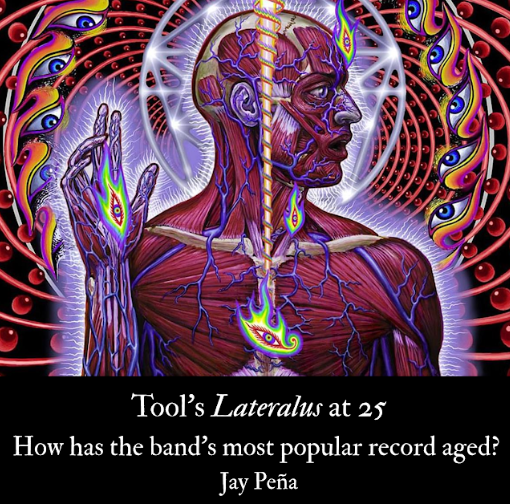
Formed in 1990 and based in Los Angeles, Tool is one of the first bands to come up in any discussion of modern progressive metal that I’ve seen. Although Tool was always a somewhat enigmatic band to me, I’m sure a great bulk of that impression came from the fact that I had never taken the initiative to further explore their discography. The only things about Tool that were apparent to me were their loyal (one might say fanatic) listeners, their distinctive bass-heavy, distorted guitar riffs that I had heard in passing, and the mildly ostentatious nature of some of their music (the song “Lateralus” having the Fibonacci Sequence integrated into it, for example; there will be more on that later). Although I suppose Tool wouldn’t be a progressive metal band if they weren’t at least a little unconventional and seen as perhaps a bit pretentious in some regards.
It was only recently that I took it upon myself to actually listen to more of what the band had to offer. Considering the fact that their most well-known album, Lateralus, turned 25 years old on May 15th this year, I figured it would be fitting to make it the first Tool album that I’ve listened to in its entirety.
The album starts off with a track that, admittedly, I’m not very partial to. “The Grudge” makes for a somewhat lackluster opener that has a pretty generic sound to it and is probably my least favourite song off the album, especially with its eight minute and 37 second long runtime. There’s a short, roughly one-minute-long song that follows, functioning as one of a handful of interludes present on the record. The album picks up significantly with the third track, “The Patient,” which expands more on the generic prog-rock seen on the first song and adds some additional, much needed melody and metal, creating an overall more engaging, interesting sound. The song is still rather long for what it is, but it marks an improvement in the album. Yet another interlude follows, titled “Mantra.” The song introduces some of the more spiritualistic, almost religious-like themes that are continued throughout the duration of the album.
The fifth, sixth, seventh, and ninth tracks make for easily some of the best songs on the album. “Schism,” easily the most popular of these tracks, is very distinct, especially in its vocals that have a staccato rhythm to them. Some songs on this record tend to have this post-grungy sound that I don’t really care for and find to be rather generic and tacky; however, “Schism” is one of the songs on this album that manages to balance that sound with a nice melody that results in a much more polished, well-produced song.
The sixth and seventh tracks, “Parabol” and “Parabola,” respectively, make for the best tracks on the entire album. Though referring to them as being two distinct tracks is a bit misleading, as the tracks have been recorded in such a way that “Parabol” seamlessly blends into “Parabola” and continues the motifs heard in the former. Moreover, the beginning of the music video for “Parabol” includes “Parabol,” so they’re best treated as being one track, even though they are not labeled as such on the album’s tracklist. “Parabol” functions as a short intro segment and does a fantastic job of setting the tone for the rest of the song. The track features a droning bassline that feels unsettling and vocals that feel almost haunting in their soft delivery of lyrics that read more like poetry and delve further into the continued themes of spirituality. “Parabola” is the larger, more energetic rock segment of the song where all of the instruments, guitar and drums primarily, are finally brought in. This track makes for the most interesting of the entire album, and it’s where the ideas and sounds introduced in the first few tracks are really developed into something more substantive.
The following track, “Tics & Leeches,” has an impressive instrumental, particularly in its drum work; though, admittedly, I’m not as fond of the vocals on this song as I was with previous ones. The title track of Lateralus, however, is a track that I find to be very interesting in both its ideas and execution. Notably, this track features the incorporation of the Fibonacci sequence in the vocals, with the number of syllables in a line corresponding to a number within the sequence. The sequence is known for being observed in nature, such as the number of petals on certain species of flowers, or its relationship to the golden ratio, making its inclusion understandable given the overall themes of the album; though, I wouldn’t fault someone for thinking its inclusion to be a bit pretentious. I personally think its execution is done fairly well, and I find “Lateralus” to be a well produced, enjoyable song and another highlight of the record.
From then on, the album introduces some more interesting themes within its sound, such as tribal drums, sitar-esque guitars, and vocals similar to that of religious hymns and chants. While fascinating in concept, the execution does not make for particularly engaging songs.
The final song of the album, “Faaip De Oiad,” is one that I find to be quite entertaining and mildly unsettling, as it’s a spoken word piece featuring a distressed man raving about aliens, “extradimensional beings,” an incoming apocalypse, and the government concealing information. It’s a fun little closer, albeit a bit startling, but that spontaneity is what makes it fun.
Ultimately, while Lateralus is largely a mixed bag and more front-loaded for my taste, I still think this album deserves the notoriety it’s received. It’s far from perfect and has its fair share of weak moments towards the end; however, its intriguing overarching concepts, distinct sound, and collection of some genuinely well-produced, well-written tracks make it, understandably, a staple of its genre. I could definitely see myself returning to tracks like “Schism” and “Parabola,” and for all its faults, the album does explore interesting ground musically at times. While it wouldn’t be my first recommendation, I certainly wouldn’t discourage a person from checking out what the album has to offer.