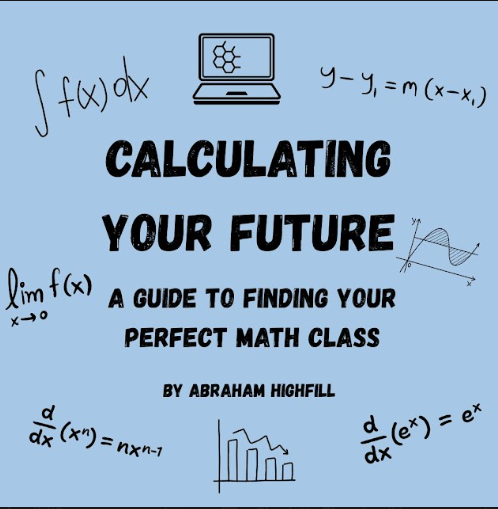
While Salem is known for its Visual and Performing Arts Academy, it also excels in STEM, offering a plethora of Advanced Placement math courses. From AP Precalculus to AP Computer Science A, the perfect math class exists for anyone here at Salem.
All math taught in school, from kindergarten on, leads to one place: calculus. As the final math course on this calculus track before calculus itself, AP Precalc completes students’ algebra knowledge by exploring many different types of functions and deepening students’ trigonometry knowledge beyond just SOH-CAH-TOA.
Much of the content of AP Precalculus is related to graphing. Units one and two cover polynomial, rational, exponential, and logarithmic functions. By the end of these units, students will be able to analyze any function they are given, whether in equation or graph form.
For many students, AP Precalculus is the first AP math class they take, which can have a great impact on their perception of higher-level math.
“Precalculus changed the way I approach problems, especially through Free Response Questions,” said junior Ryan Zhu. “These questions challenge you to think more deeply by applying math to real-life scenarios. For example, FRQ 3 on the exam often requires you to use multiple concepts instead of relying on a single formula. This helped me realize that math is not just about getting the correct answer, but about understanding the process and explaining your reasoning.”
AP Calculus is the capstone of all high school math. Split between two courses, both AP Calculus AB and AP Calculus BC provide the foundation for one of the most impactful branches of mathematics.
Calculus is the mathematical study of change. Because practically everything related to science or math deals with change, any piece of technology you use relies on calculus.
“Other than helping me understand AP Physics, [AP Calculus AB] allowed me to gain more information from functions and graphs,” said junior Killian Adams. “I know how to find the rate it’s increasing or decreasing, find the area underneath the graph, and apply limits to understand continuity. This has all helped me find a lot more data from a lot less data because of Calc AB.”
AP Calculus BC includes all units that AP Calculus AB does and adds two additional units. This allows it to count for a full year of college calculus instead of just one semester. However, this doesn’t make it substantially harder.
“Personally, I think the biggest myth surrounding this class is its difficulty,” said junior Li Reyes, “Many believe this class is substantially harder than AB & Pre-Calc. While it is faster paced than AB, I’ve found, in my class, that we still get an entire day to cover each topic.”
Because all of the concepts in calculus are tightly connected, the extra content in BC doesn’t add very much to the difficulty
“There’s not much extra content in BC (around 2 units), and, of the extra content, most of it is related to previous lessons,” Reyes said.
As a prerequisite to either of the AP Calculus classes, the concepts learned in precalculus are relevant in calculus. As a piece of advice to future students, Adams said to “Look back at what you learned in pre-calc. Pre-calculus, as the name implies, literally helps you understand everything in Calculus. It doesn’t teach you the same concepts, but it gives you the tools that are extremely helpful for the course.”
AP Statistics is the most unique of all of the AP maths. Because it deviates from the normal calculus track, a student’s experience in other math classes doesn’t hold much weight in stats.
“AP Statistics is more English than math,” said junior Alex Clark. “It is a lot of reading and writing.”
AP Statistics is more about drawing conclusions from data rather than performing arithmetic. Because many students have not been exposed to statistics very much before, the course starts by defining different types of data, graphs, and residuals before moving on to basic probability. In the second half of the course, the focus is on significance tests. These mathematical processes involve sample data being compared to hypotheses and its significance determined.
AP Statistics is also the most applicable of all the maths. While calculus is the cornerstone of physics and engineering, statistics has many applications in the medical and business worlds. Every doctor has had to read scientific studies that use statistical concepts, and every economist has had to predict what the market will do based on past trends.
According to the College Board, Computer Science classes fall under mathematics rather than science. Rather than being investigative like biology or chemistry, they are highly analytical, relying on logic, algorithms, and structured problem-solving to build solutions from the ground up.
AP Computer Science Principles (CSP) serves as the perfect entry point for students curious about the digital world. Rather than focusing exclusively on typing out lines of code, CSP offers a broad, accessible overview of how computing shapes society.
The course covers a wide range of foundational topics, including the mechanics of the internet, cybersecurity, big data, and the global impact of technology. Students do learn introductory programming, often focusing on the creative process of designing basic apps or algorithms, but the “math” here is more about computational thinking than crunching numbers. Because the class leans heavily into real-world applications rather than rote formulas, students often find the material changing how they interact with everyday technology.
“When I look at a weather app now, I notice that it is using GeoJSON data to map out coordinates,” said senior Serena Xie. “The concepts we’ve learned are easy to incorporate into daily life because AP CSP is about way more than just the principles of coding; it also helps us understand things from the real world.”
For students looking for a more rigorous, specialized dive into coding, AP Computer Science A (CSA) is the next logical step. AP CSA is built entirely around object-oriented programming using Java. Students are tasked with designing, writing, and analyzing complex programs. The course challenges students to think like software engineers, testing their ability to debug code, manage data structures, and build algorithms from scratch.
Because of its heavy emphasis on conditional logic and step-by-step problem solving, many students find that CSA exercises the exact same mental muscles as upper-level calculus or physics classes. Despite the intimidating nature of the coursework, however, prior coding experience is not required.
“The biggest misconception about AP Computer Science A is that you need to have taken a computer science class or have some background knowledge on the subject,” said senior Kaitlyn Thomas. “I went into this class knowing absolutely nothing about computer science, and I have been able to understand the content and complete my work throughout the year.”
Because the course builds heavily on itself, mastering the foundations early is critical to surviving the year.
“If I could go back to day one, I would tell myself to make sure I had a strong understanding of our first few units,” Thomas said. “Like in any math class, understanding the basic information greatly helps learning later in the course.”
Whether your future involves analyzing market trends with statistics, engineering new technology with calculus, or developing software with computer science, the tools you need are already here. Ultimately, the math department at Salem proves that there is no single “right” way to do math. Every student has a different destination in mind, and the variety of AP courses ensures there is a specific pathway to help them get there.