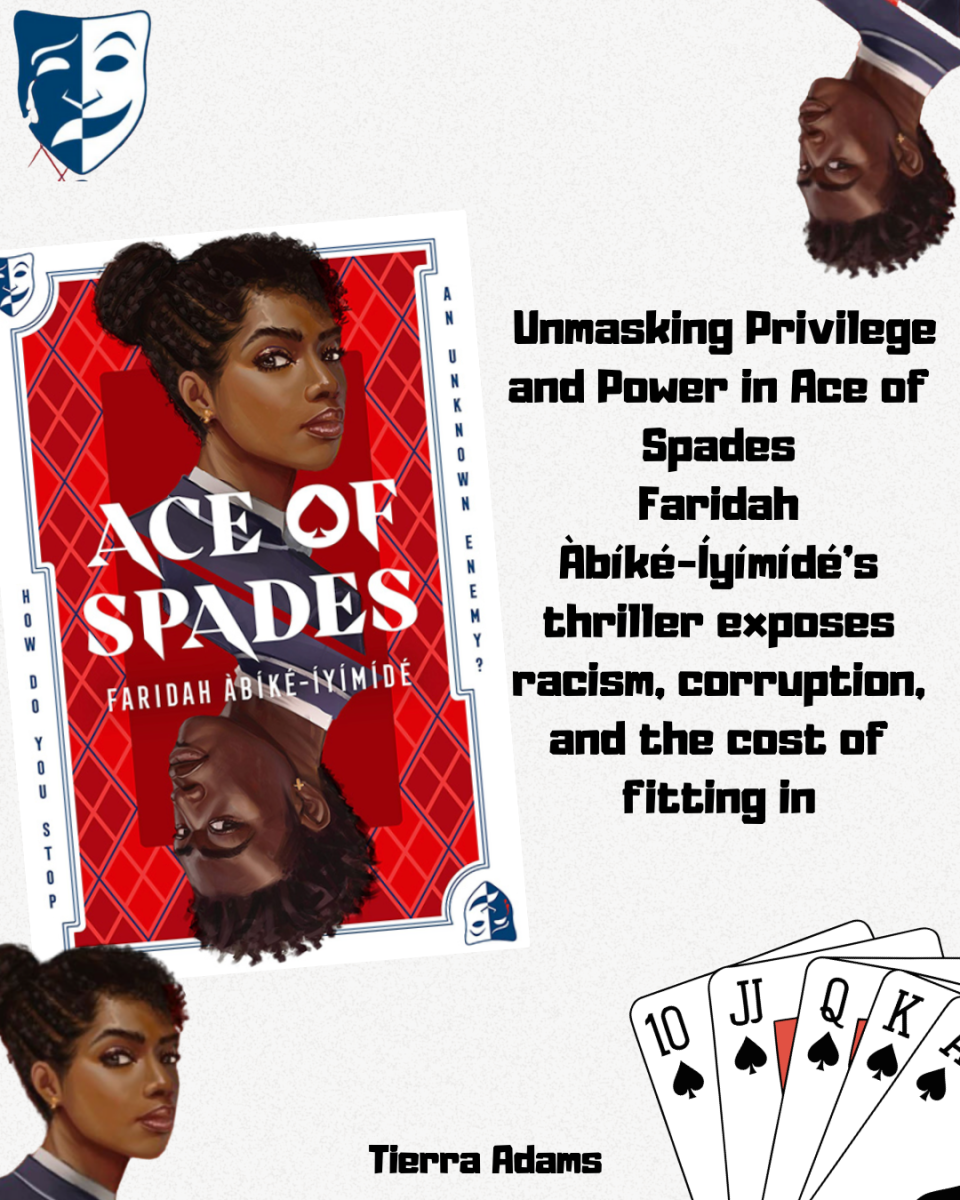
Ace of Spades by Faridah Àbíké-Íyímídé tells the story of Devon Richards and Chiamaka Adebayo, the only two Black students at Niveus Academy. As they begin their senior year, both are honored with the title of Senior Prefect, a student leader who acts as a role model for their specific class. This sets the stage for what seems like a promising final year. Soon after the announcement, they begin to receive anonymous messages from someone calling themself “Aces.” These messages expose their personal secrets and slowly start to ruin their lives. As the story unfolds, Devon and Chiamaka realize that what’s happening to them isn’t random, but it’s connected to the deep racism and corruption present in their school.
“Ace of Spades resonated deeply with me, as the key struggles it represents powerfully reflect issues in modern life, ” said senior Aiyanna Nugent.
The book is written from a dual point of view, switching between Devon and Chiamaka’s lives. Focusing on music and his scholarship, Devon leads a quiet lifestyle, while Chiamaka is the queen bee of Niveus Academy: popular, confident, and socially powerful. Their worlds could not be more different, but in chapters 11–13, they meet for the first time and slowly begin to form a connection.
Spoiler Alert!
Through Devon’s perspective, readers see the struggles of a student from a low-income background trying to succeed in an elite private school built on wealth and privilege. Attending Niveus on a scholarship, Devon constantly fears that one mistake could destroy his future. He carries the weight of supporting his mother and younger brothers, hoping to make them proud and use college as his escape. When “Aces” begins exposing secrets about his sexuality and personal life, Devon’s sense of safety and belonging starts to crumble. Trapped between being black, poor, and queer in a space designed for white privilege, Devon wrestles with fear, identity, and the pressure to be perfect in a world that refuses to accept him.
From Chiamaka’s point of view, readers see the challenges of a girl who seems to have everything but is fighting to keep her image together. Although she is smart, popular, and successful, she slowly realizes that her achievements cannot protect her from racism. Chiamaka believes that acting perfect and fitting in with her wealthy white classmates will make her equal, but Aces’ attacks prove otherwise. She feels constant pressure to maintain her image as a top student, fashion icon, and leader at Niveus, hiding her insecurities behind confidence instead of showing her weaknesses. As the story continues, Chiamaka faces betrayal from people she once trusted and learns how quickly those around her can weaponize her secrets.
“The anti-black racism and discrimination that Devon Richards and Chiamaka Adebayo face, fueled by white students who show racial prejudice and persistent microaggressions, was particularly difficult to read,” said Nugent.
I had to pause often because it reminded me of my own experiences growing up after moving away from Jamaica and the predominantly black neighborhoods. The book skillfully highlights hidden struggles, such as the homophobia and classism that Devon endures. The bullying and outing of his personal life were especially cruel, showing how the antagonists weaponized his intersecting identities.
Both Devon’s and Chiamaka’s experiences reveal the deep racism and corruption hidden within Niveus Academy. As “Aces” continues to expose their secrets, they eventually uncover the truth that the school runs a racist system designed to destroy the futures of its Black students. Devon and Chiamaka realize they are not the first victims but are instead part of a long pattern of discrimination meant to keep Niveus’ image “white and elite.” This discovery forces them to face the reality that success within a corrupt system will never truly protect them. By working together to expose the truth and survive the attacks, Devon and Chiamaka find strength in unity. Their fight against “Aces” becomes more than a battle for their reputations; it becomes a fight for justice, identity, and the right to exist in spaces built to exclude them. The novel ends with both characters reclaiming their power, showing that even when society is rigged against them, truth and courage can still break through oppression.
Reading Ace of Spades made me think about how racism can exist in places that seem perfect on the surface. Àbíké-Íyímídé shows that discrimination isn’t always loud or obvious; it can hide behind rules, traditions, and privilege. Through Devon’s and Chiamaka’s experiences, the book reveals the difficulty of fighting against systems that are built to exclude people like themselves. I give it a 10/10 rating because what stood out to me the most was Devon’s and Chimaka’s courage , even when the truth was painful; this is something that I can connect with in my life.
“Ace of Spades sounds like an interesting book that I haven’t read, but if given time, I would definitely do so, ”said senior Devin Jiang. “Based on information from some peers, the book is definitely worth the read.”
Ace of Spades is more than just a mystery; it’s a story about power, identity, and fighting for justice. It leaves readers questioning what equality really means and reminds us that silence only helps the system stay the same.