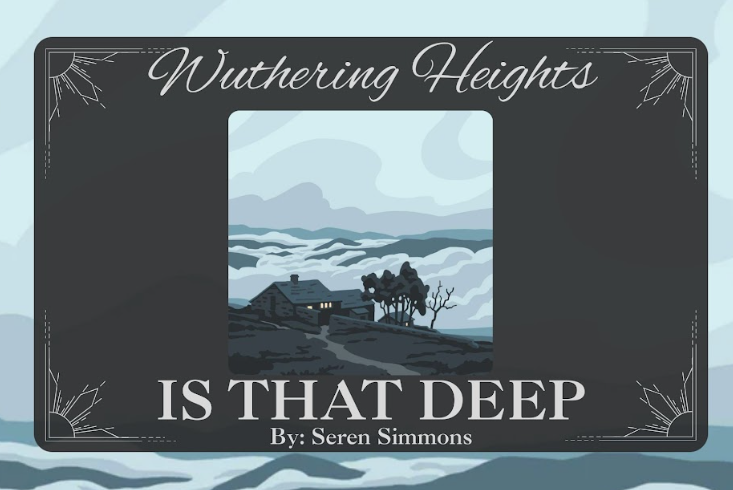
After the new movie “Wuthering Heights” by Emerald Fennell was released, many people who had read the book took issue with the “creative liberties” that changed many aspects of the story. Other people, who for the most part had not read the book, thought the movie was entertaining.
I wanted to read the book first, since, even though from my impression, the movie was never trying to be anything like the book. Also, I had never read the novel before, so if I was going to have an opinion in this discourse, I wanted to have some context.
I’ll first detail a short summary of the book in my own words, and then I will talk about the following categories: characters, writing style, and message.
SUMMARY
The story follows the narration of the long-term servant, Nelly of the Earnshaw and Linton families, who watched the characters Catherine Earnshaw and Heathcliff grow up. She details how Heathcliff was brought by Mr. Earnshaw from Liverpool and was an outcast due to his race. However, Heathcliff found friendship in Catherine; they were always together as children playing on the Yorkshire moors. Later on, though, Catherine wishes to marry Edgar Linton because marrying Heathcliff would be “degrading.” Heathcliff feels betrayed and runs away. As an adult, Heathcliff returns only to wreak havoc generationally on the Linton and Earnshaw families.
CHARACTERS
Personally, what I found most interesting about the story was the complicated character arcs and how every character’s action had an observable consequence. The most notable example would be with Heathcliff; he starts as an outsider to the Earnshaw family. He is regarded not even as a person but as an “it,” and he spends most of his early years being abused by the eldest brother, Hinley. His only form of connection is Mr. Earnshaw, Catherine, and, later, Nelly.
Except Mr. Earnshaw dies early on, leaving him solely relying on love and friendship from Catherine. But Catherine cannot spend all her time with Heathcliff since she is meant to portray herself as upper class, so Catherine ends up spending more time with the Lintons (specifically Edgar Linton). This weighs on Heathcliff, who feels even more inadequate and abandoned. While talking with Nelly about it, he says, “I wish I had light hair and fair skin…”
All of this buildup leads Heathcliff to slowly become more and more unfeeling towards people. By the end of the story, he acts like his abusers in the beginning. I found this character arc upsetting, yet a reflection of how systematic oppression only rears cruelty. Heathcliff did not start cruel; he became cruel in response to what he endured.
WRITING STYLE
Another thing that intrigued me about the book was how it was narrated. The story actually begins with a man named Mr. Lockwood, who is being told the story by Nelly. Sometimes, though, Nelly is telling Mr. Lockwood a retelling of another character’s story in her own story. I have never read a book that has done something like this, and it leads one to believe everything being told is biased.
This leaves the story loose and lets the reader interpret a lot of subtext. An example of this is the relationship between Catherine and Heathcliff. To me, (at least from my modern perspective of what the romance genre is), the story never explicitly showed a romance, even though that is what it is often referred to as. Instead, it showed an intertwining obsessive love that Nelly did not really understand.
For instance, when Catherine is talking to Nelly about Edgar and Heathcliff, she describes how her relationship with each of them is different. Catherine goes on to say, “I AM Heathcliff! He’s always, always in my mind: not as a pleasure, any more than I am always a pleasure to myself, but as my own being.”
Nelly sees this declaration as “folly” and Catherine as selfish. However, the dialogue in the story leads the reader to partly see how Catherine’s side of the story is likely different. Yet we will only know part of how she viewed her relationship with Heathcliff due to Nelly being the narrator.
MESSAGE
The message that I pulled from the overall story had less to do with the relationship of Heathcliff and Catherine, but how each of the characters was treated due to their class, status, and race. The story starts with Nelly pointing out how Heathcliff was treated unjustly based on his race, and later on, she points out the unjust treatment of Hareton, Hindley’s son, who was deprived of an education.
An example would be when Nelly scolds the daughter of Catherine, Cathy, for making fun of Hareton: “To sneer at his imperfect attempt was very bad breeding. Had you been brought up in his circumstances, would you be less rude?”
In my interpretation, she is saying that how you treat others matters, and you should show kindness to those less fortunate. This message can be seen throughout the book because it is the one Nelly clearly wants the listener to know. As far as I’m concerned, it is the most valuable message anyone can take from this story, featuring a cycle of cruel people destroying themselves.
Overall, I believe this book was very profound and groundbreaking for its time. It grapples with so many themes that I cannot fully detail them in a few paragraphs. Honestly, anyone watching the movie “Wuthering Heights” without having read the novel should stop by a library.