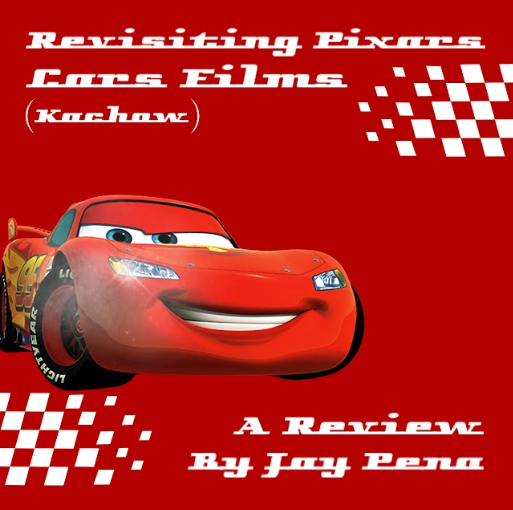
When I was about toddler age, I loved watching animation. I was still around that age where movies with “real actors” weren’t engaging enough for my tiny toddler brain, so instead I watched various cartoons and animated films, usually those from Disney and Pixar. Among these films, Cars left the greatest impression on me.
I was the biggest fan of this movie. I watched it every other night for at least a year. I had a pair of Cars themed pajamas and a set of Cars themed bedsheets. I have no real idea why this film in particular captivated me the way it did; I just remember that I absolutely adored it. Fast forward to today, I was searching through some old DVDs in a familial collection that was given to me, and lo and behold there was that copy of Cars that I would watch non-stop. I was inspired to revisit the franchise, of which there are three films.
Cars
The first Cars film is easily the best out of all three. Released in 2006, Cars tells the story of an up-and-coming, rookie racer, anthropomorphized car named Lightning McQueen. There are really only a few main aspects to McQueen’s character: he’s arrogant; he is determined to win the Piston Cup (which is basically this universe’s version of NASCAR races); and his catchphrase is “kachow,” hence his name (very creative, I know).
The movie follows a familiar plotline where the arrogant, privileged protagonist is placed into a different environment with people the exact opposite of the protagonist, which in the case of this movie takes the form of a small Arizonan town of Radiator Springs that is inhabited by friendly, down-to-earth, rural car-people-creatures (?), and through this experience the protagonist will change his ways and learn to be better person and usually obtain some sort of reward in return such as friendship or achieving a goal of some sort.
The film isn’t particularly special, especially compared to what I and many others consider to be Pixar’s magnum opus that would be released only the next year, Ratatouille, but it’s by no means a bad film. It’s entertaining enough to keep an audience captivated (it certainly was for five-year-old me), the animation is nice, Owen Wilson gets to be Owen Wilson, which is also nice, and the plot, albeit generic, is well done. It’s an easily understandable, cute story of a car-person learning humility. I want to focus on the mundanity of this plot because the same can not be said for the absolute haphazard mess that is “plot” to the sequel of this movie.
Cars 2
When I began to watch Cars 2, I thought I knew what I was in for. I remembered the plot from watching it the few times I had when I little: Lightning McQueen faces off against an Italian car named Francesco Bernoulli in a European race to defend his honor after his girlfriend Sally makes a few remarks drooling over the Bernoulli’s “open-wheels” (yeah, there’s a lot of weird car innuendos in this series that I’ve skipped over out of a desire [and inability] to explain them in a not weird way). When McQueen decides to travel to this international race with his country-bumpkin best-friend Mater (seen in the previous film), hilarity ensues. At least, that’s what I remembered of the plot.
So you can imagine my bewilderment when I found out that the movie also had a B plot that consists of (stay with me here) a car espionage organization in which a car named Finn McMissile. McMissile, whose character was 100% modeled after James Bond down to the English accent, alongside his assistant Holley Shiftwell, are tasked to infiltrate an underground syndicate of jealous cars, who have been labeled “lemons” for being models that are notorious for having issues, that decide to poison the brand of gas that is sponsoring this international race in order to sabotage the company. If that incredibly brief explanation of this subplot sounds absurd and insanely busy to you, that’s because it is.
This plot is only barely tied to the main plot through Mater, who finds himself somehow getting wrapped up into the spy mission and becoming a spy against his knowledge. This subplot is so forgettable that despite making up at least half of the film I had completely erased all of it from my mind. This movie is ridiculous enough that I want to give it credit for its absurdity, but it’s so forgetful that I can’t bring myself to do that. It’s not even ridiculous in an entertaining way which is the worst part of it all. Overall, a bad sequel to a decent movie that had the opportunity to at least be fun but did not take it.
Cars 3
Cars 3 is perhaps the most interesting installment of the Cars franchise even if it is not my favorite. It follows Lightning McQueen becoming obsolete and becoming the mentor to a new up and coming rookie in a similar position that McQueen was in during the first film 11 years ago. Cars 3 is not the greatest or the most interesting of a watch experience; however, I can still appreciate the general message the film delivers of passing the torch on to future generations and being able to move on from certain periods of life and enter into new chapters.
It’s a pretty ironic message for Disney-Pixar to give considering their tendency to take popular films and drag them far beyond their expiration dates (example: the Toy Story movies). I suppose we should just be glad that Cars ended here as opposed to the hypothetical 2036 release of Cars 7.
Overall, the Cars franchise was a pleasant one. It certainly was nostalgic to revisit one of my favorite childhood films, and while the series is far from perfect, I think it’s still emblematic of a time where Pixar was able to bring new ideas to a franchise, even if those ideas were outlandish (*cough* Cars 2), and more importantly, I think this franchise represents a time where Pixar was aware enough to know when a film franchise should be put to rest. I’m glad the Cars movies exist, and I’m glad that they’ve come to a close. It was the end of the road for the franchise, and it was pretty good while it lasted.